

Table of Contents
If the rest of your camera rig is already dialed in, the teleprompter is often the last piece that still slows things down. Mounting takes longer than it should, lens compatibility is not always clear at a glance, and adding accessories often means extra brackets. For mirrorless shooters, DSLR users, and fixed studio teams, those hardware details usually matter more than software. This guide compares three NEEWER teleprompters from that perspective, with the X11 leading for users who want a built-in screen plus more flexible mounting and expansion options.
Comparison Table of the Best Teleprompters
|
Built-in Screen |
Quick Release / Mounting |
Light Transmittance |
Readable Distance |
Hardware Highlight |
Best For |
|
|
9" LCD (1024x768) |
Arca-type quick-release plate, 1/4", 3/8", dual cold shoes |
75% |
Up to 2.5m |
Supports lenses with filter threads up to 72mm and doubles as a second monitor |
Mirrorless rigs, desk studios, hybrid streaming, and camera work |
|
|
No built-in monitor |
501PL-compatible quick release, 1/4", 3/8" |
71% |
Up to 4m |
44lb/20kg load support and larger reading area for fixed studios |
Heavier studio cameras, long scripts, and wider camera placement |
|
|
No built-in monitor |
1/4" and 3/8" thread holes |
75% |
Up to 3m |
Aluminum alloy no-assembly design with RT113 remote control |
Budget-conscious fixed setups and tablet-based prompting |
Why Quick Release Matters for Mirrorless Camera Rigs
If you regularly move between tripod heads, desk stands, and teleprompter setups, your quick-release system affects speed more than almost any other hardware detail. A teleprompter may look compatible on paper, but if it interrupts how you normally mount and remove your camera, the setup becomes harder to repeat consistently.
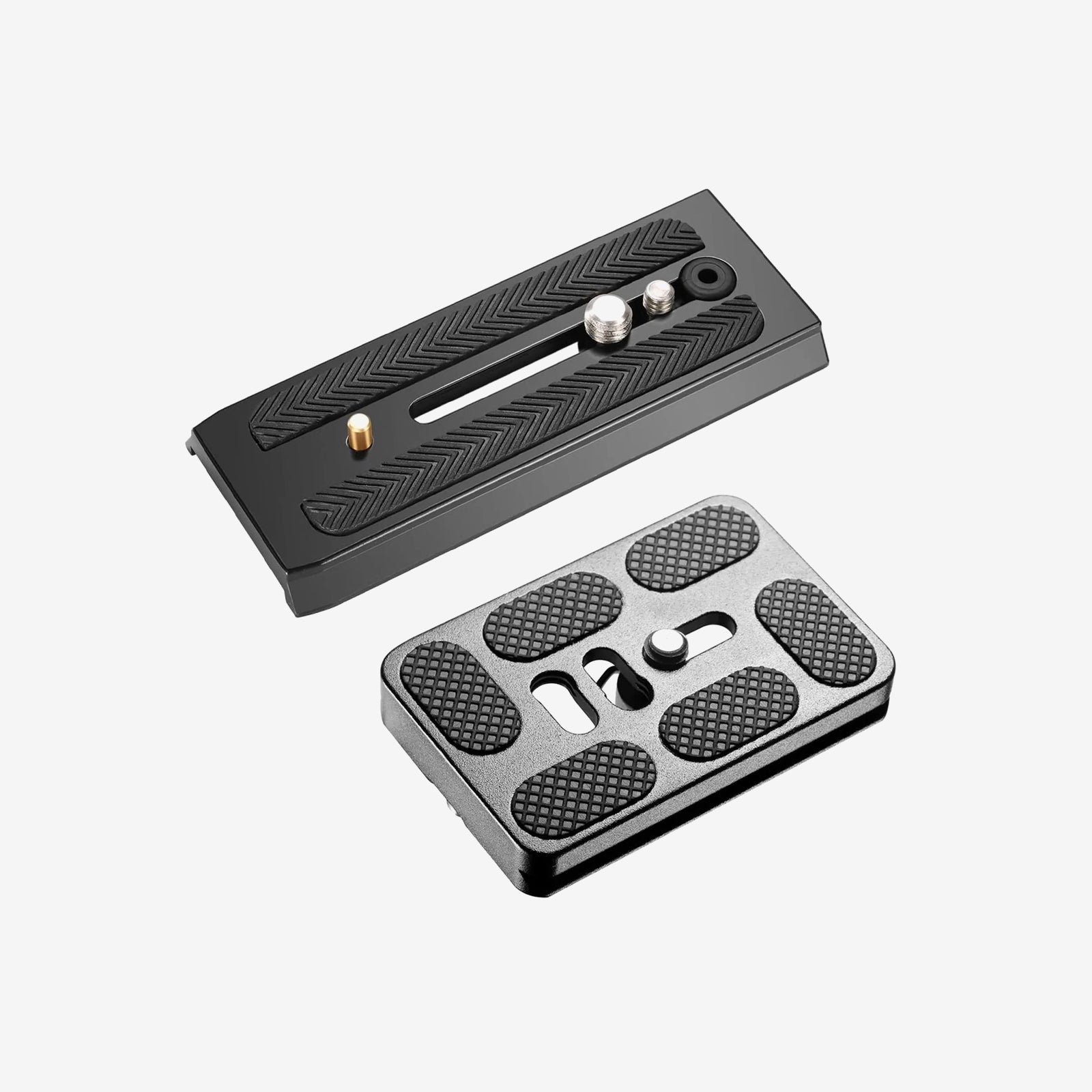
For mirrorless shooters, the NEEWER X11 stands out because it includes an Arca-type quick-release plate. It fits naturally into setups that already use the Arca standard and allows you to mount a smaller camera body quickly without rebuilding the front of the rig each time. It also provides horizontal movement up to 3.9" (10 cm) and vertical elevation up to 1.2" (3 cm) for more precise lens alignment. If you want a teleprompter with its own screen that still integrates smoothly into a mirrorless workflow, the X11 is the easiest fit in this comparison.
The NEEWER X17 II takes a different approach. Its quick-release system is 501PL-compatible, which is especially useful in studio environments where heavier DSLRs or camcorders move between the teleprompter and a tripod head. That makes it less mirrorless-focused than X11, but better suited to larger studio workflows.
The NEEWER BASICS X12B is the simplest of the three. It does not include Arca or 501PL quick-release hardware, but it does provide 1/4" and 3/8" thread holes along with a liftable platform. That makes it workable for fixed rigs where lower cost matters more than fast camera switching.
Once the mounting system fits your workflow, the next question is usually the glass itself—how clearly you can read, and whether your lens will work with it.
Beam Splitter Quality and Lens Thread Compatibility
For most camera users, the glass is one of the first things they look at—and for good reason. You want text that is easy to read, but you also want a setup that performs reliably once a real camera and lens are in place.
The NEEWER X11 uses an 11" beam splitter with 75% light transmittance and a multiple coating designed to reduce ghosting. It is also the most specific model here for lens compatibility: NEEWER states that it supports lenses with filter thread sizes up to 72mm and focal lengths from 35–200mm. If you are trying to match a teleprompter to a 72mm lens-thread camera without guesswork, X11 is the most clearly documented option in this group.
The X17 II uses a larger 17" HD clear beam splitter with 71% light transmittance. In practice, that gives you a larger reading surface and longer comfortable viewing distance, even though the stated transmittance is slightly lower than X11. It is the better fit when comfortable reading distance matters more than compactness.
The X12B uses a 12" beam splitter with 75% light transmittance and a focal-length note of more than 28mm, while also warning that it is not compatible with wide-angle lenses. Its adjustable lens hood supports different lens sizes, but it does not provide the same clearly defined 72mm limit as the X11. That makes X12B more of a general-value option than a precision choice for buyers who need very specific lens-thread guidance.
Beyond the glass, how well the teleprompter integrates with your existing accessories and how far back your camera sits also affect daily usability.
Cold Shoe Expansion and 8-Foot Reading Range

A teleprompter becomes significantly more useful when it fits into the rest of your rig without requiring extra brackets or adapters. That is why accessory expansion matters almost as much as the glass itself.
The NEEWER X11 is a practical choice if you want to mount a microphone and a fill light directly on the teleprompter—its two built-in cold shoe mounts make this straightforward without extra brackets. At 2.5m, it also covers the 8-foot reading range that most desk and mid-room setups need. If your camera sits farther back, X17 II becomes more attractive. Its 4m reading distance is much more forgiving for wider studio framing, and its larger glass area reduces strain during longer reads. The X12B also meets the 8-foot requirement with a 3m reading distance, but it does not offer the same built-in accessory-expansion story as X11.
What Makes a Teleprompter “Rig-Friendly”?
A teleprompter that fits well into a camera rig usually comes down to four practical factors:
- Mounting – Compatibility with your existing quick-release system or tripod setup
- Lens fit – Clear support for your lens size and focal length
- Expansion – Ability to add accessories like microphones and lights without extra hardware
- Workflow – How easily it fits into your shooting process without adding friction
Best Teleprompters in 2026
1. NEEWER X11 2-In-1: Best All-in-One Rig for Mirrorless Cameras

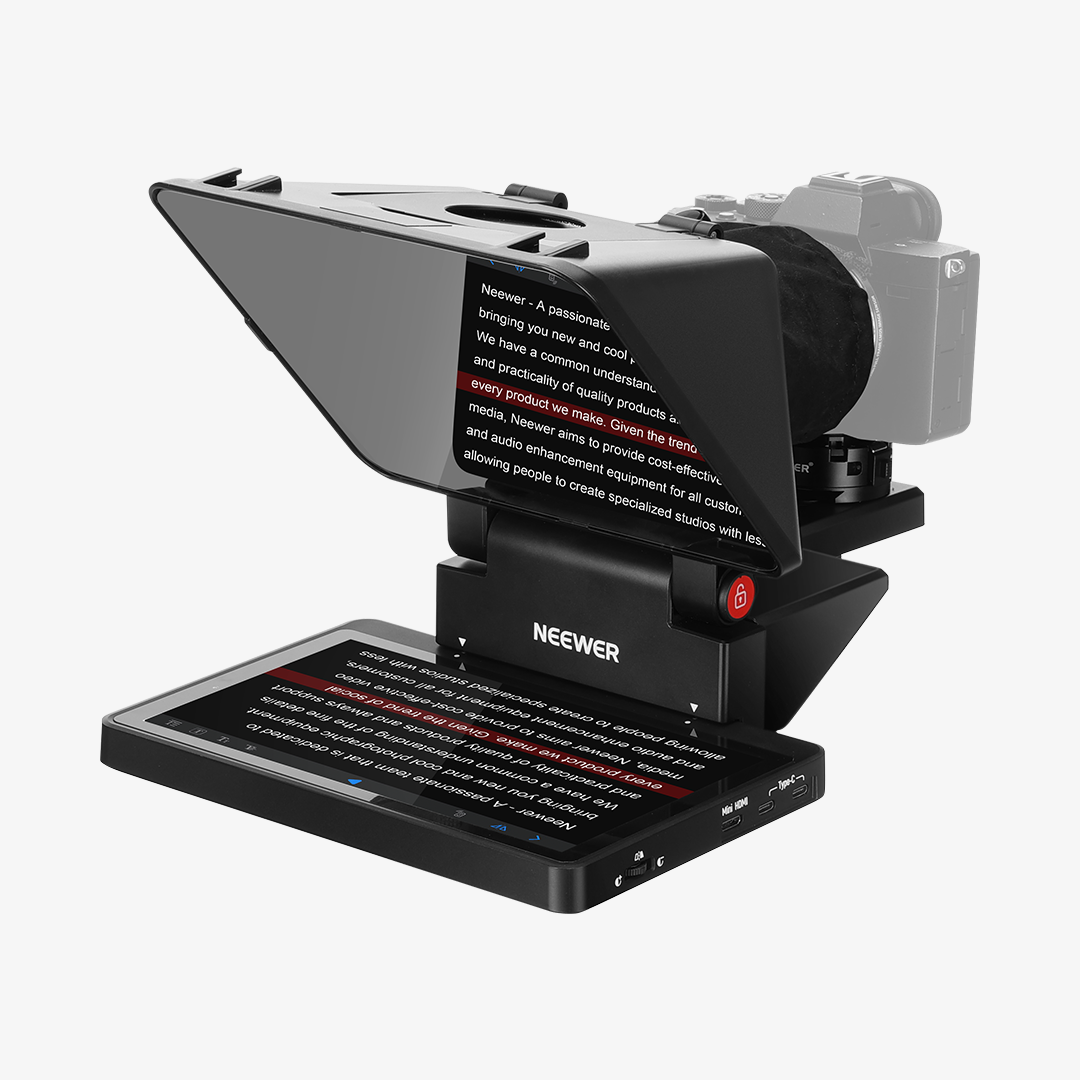
If you want one teleprompter that covers the widest range of needs discussed in this guide, the NEEWER X11 2-In-1 is the leading recommendation. It combines the hardware points that matter most for modern mirrorless and desk-based workflows: a built-in 9" LCD, Arca-type quick-release support, dual cold shoes, multiple mounting points, and explicit support for lenses up to 72mm thread size. That combination gives it the most balanced feature set here for buyers who care about setup speed, optical clarity, and cleaner rig integration.
Its biggest advantage is workflow consolidation. Because the screen is already built in, there is no need to mount a separate tablet just to get started. It can also work as a secondary display for Windows or macOS, and supports direct phone or tablet mirroring via the included cables. For users who switch between streaming, camera-based recording, and presentation work, that reduces the amount of gear hanging off the front of the setup.
The Breakdown
- Integrated screen workflow: Built-in 9" LCD (1024x768) reduces reliance on external devices.
- Mirrorless-friendly mounting: Arca-type quick-release plate supports faster camera installation and removal.
- Lens compatibility clarity: Supports lenses with filter thread sizes up to 72mm and 35–200mm focal lengths.
- Optical performance: 11" beam splitter with 75% light transmittance and multiple coatings to prevent ghosting.
- Accessory expansion: Dual cold shoe mounts support a microphone and fill light on the same rig.
- Flexible positioning: 1/4", 3/8", horizontal, and vertical adjustments help center the lens more precisely.
Key Parameters & Configuration
|
Important Parameter |
X11 Spec |
Use-Case Value |
|
Built-in Display |
9" LCD, 1024x768 |
Faster setup with fewer external devices |
|
Beam Splitter |
11", 75% transmittance |
Clear reflected script with low-friction daily use |
|
Readable Distance |
Up to 2.5m |
Covers 8-foot reading needs for desk and studio-medium framing |
|
Quick Release |
Arca-type QR plate |
Easier mirrorless camera mounting in repeat setups |
|
Lens Compatibility |
Up to 72mm filter thread, 35–200mm focal length |
Best defined option for camera-lens matching |
|
Expansion |
Dual cold shoes, 1/4", 3/8" |
Cleaner rig building with mic and light support |
Pros
- Best match for users who specifically want a built-in-screen teleprompter
- The Arca-type quick-release plate makes it more convenient for mirrorless shooters
- Dual cold shoes support a more complete front-of-camera rig
- Clear, explicit 72mm lens-thread compatibility guidance
- Can work as a second monitor or phone-mirroring display
Cons
- 2kg / 4.4lb payload is not aimed at heavier studio builds
- For first-time HDMI cable use, some computer setups may require driver installation
- Smaller reading area than X17 II for very long scripts
Best for: Mirrorless users, DSLR shooters with lighter front-end rigs, livestream studios, creators who need cold shoe expansion, and buyers who want a built-in-screen teleprompter with the most complete hardware feature set.
2. NEEWER X17 II: Best for Heavy Studio Cameras and Long-Distance Reading

If your priority is not a built-in monitor but a larger professional reading platform, the NEEWER X17 II becomes the better choice. It is especially well-suited to fixed studio setups, heavier camera systems, and longer reading distances. Its 17" beam splitter, 4m readable distance, and 44lb / 20kg load support all point toward a more studio-oriented use case.
The quick-release story is also different from X11. Instead of Arca, X17 II uses a 501PL-compatible quick-release system that can be pressed in from the top and locked quickly. That is especially useful for users already working with larger video heads or camcorder-style support systems.
The Breakdown
- Large reading area: 17" beam splitter supports easier reading during long sessions.
- Long-distance comfort: Up to 4m reading range suits wider framing and larger studios.
- Studio-grade switching: 501PL-compatible quick release is convenient for larger support systems.
- High payload support: Handles DSLR cameras and camcorders up to 44lb / 20kg.
- Alignment control: Vertical adjustment and sliding track help center the lens precisely.
- Remote operation: Includes RT113 remote plus app control for script management.
Key Parameters & Configuration
|
Important Parameter |
X17 II Spec |
Use-Case Value |
|
Beam Splitter |
17", 71% transmittance |
Larger reading area for studio work |
|
Reading Range |
Up to 4m / 13ft |
Better for wider camera placement |
|
Quick Release |
501PL-compatible plate |
Smoother switching for studio-oriented rigs |
|
Load Capacity |
44lb / 20kg |
Better suited to heavier cameras and camcorders |
|
Camera Adjustment |
56-89mm vertical, 248mm track slide |
More flexibility for centering larger setups |
|
Control Method |
RT113 remote + app |
Practical pacing control during recording |
Pros
- Best long-distance reading comfort in this comparison
- Stronger support for heavier studio cameras
- 501PL-compatible workflow suits studio production environments
- More forgiving for long scripts and wider shots
Cons
- No built-in monitor
- Less aligned with Arca-based mirrorless workflows
- Larger footprint than X11 or X12B
Best for: Studio videographers, heavier DSLR or camcorder users, interview sets, and teams that prioritize reading comfort and rig capacity over all-in-one monitor convenience.
3. NEEWER BASICS X12B: Best Budget Tablet-Based Teleprompter

The NEEWER BASICS X12B is the most economical choice in this comparison, and it makes sense when your priority is a simpler fixed setup rather than a built-in display or a quick-release ecosystem. It features a no-assembly aluminum alloy design, includes an RT113 remote, and offers 75% light transmittance with a readable distance of up to 3m. For tutorials, classroom recording, and basic studio use, that may be all you need.
Its positioning should still be understood clearly. The X12B is not the best fit if you specifically want a built-in monitor, Arca-type quick-release support, or cold shoe expansion. NEEWER also notes that it is not for phone shooting, and that phones mounted on the prompter are for text display only. That makes it more of a value-oriented tablet teleprompter than a full front-end rig solution.
The Breakdown
- Budget-first construction: Aluminum alloy body with no-assembly design keeps the setup simple.
- Readable prompting: 12" HD display area with 75% light transmittance and up to 3m readability.
- Basic fixed-rig mounting: 1/4" and 3/8" thread holes support conventional placement.
- Control workflow: RT113 remote plus app control for page and speed adjustments.
- Carry-friendly structure: Foldable form with a carrying bag supports storage and transport.
- Important limitation: Not for phone shooting; phones are for text display only.
Key Parameters & Configuration
|
Important Parameter |
X12B Spec |
Use-Case Value |
|
Beam Splitter |
12", 75% transmittance |
Clear prompting for everyday shooting |
|
Readable Distance |
Up to 3m / 10ft |
Covers 8-foot reading needs comfortably |
|
Material |
Aluminum alloy |
Better durability in daily fixed setups |
|
Mounting Points |
1/4" and 3/8" thread holes |
Flexible placement on common support gear |
|
Control Method |
RT113 remote + app |
Easy basic script control |
|
Compatibility Notes |
Tablet/iPad prompting, not for phone shooting, focal length over 28mm |
Best treated as a tablet-based value option |
Pros
- Most affordable option in this comparison
- Aluminum alloy build is solid for the segment
- A 3m reading range is still practical for many fixed setups
- Simple no-assembly design is easy to repeat
Cons
- No built-in monitor
- No Arca-type quick-release plate or cold shoe mounts
- Not for phone shooting
Best for: Budget-conscious users, tutorial and course recording setups, tablet-based prompting, and buyers who want a basic fixed teleprompter without paying for higher-end rig features.
Common Questions About Camera-Compatible Teleprompters
Q1: What is the best built-in-screen teleprompter for a mirrorless camera?
The NEEWER X11 is the most complete fit because it combines the built-in 9" monitor, Arca-type quick-release plate, multiple mounting points, and dual cold shoes in one product. If your workflow starts with a mirrorless camera and you want fewer extra parts around the lens, it is the easiest model here to build around.
Q2: Which NEEWER teleprompter works best for reading at about 8 feet away?
All three can cover that distance, but they serve different setups. X11 is rated up to 2.5m, which directly covers the 8-foot requirement while also adding a built-in monitor and accessory expansion. X12B reaches 3m and works if you want a lower-cost tablet-based setup. X17 II reaches 4m and is the better choice if your camera is placed much farther back.
Q3: Will a teleprompter like this ruin image quality?
These models use beam splitter glass, allowing you to read text while shooting through it. In practice, overall image quality depends more on lens compatibility and setup than on minor differences in transmittance.
Q4: Which model should I choose based on camera type and shooting scenario?
- Mirrorless shooters and hybrid desk studios: Choose X11 for Arca-type quick-release support, dual cold shoes, and the built-in monitor.
- Heavier studio cameras or long-form production: Choose X17 II for its 501PL-compatible plate, higher payload support, and 4m reading range.
- Budget-first tablet prompting setups: Choose X12B if you do not need a built-in monitor and want a simpler aluminum-alloy teleprompter for fixed use.
Final Takeaway
If your goal is to find the most complete hardware match for a professional camera rig, the NEEWER X11 is the best place to start. It combines a built-in monitor, Arca-type quick-release support, dual cold shoes, and explicit 72mm lens-thread compatibility guidance in one package. For mirrorless users and smaller professional rigs, that makes it the most versatile option here.
The other two models still have clear roles. X17 II is the better pick when your studio uses heavier cameras and longer reading distances, while X12B is the value option for tablet-based prompting and simpler fixed setups. The right choice depends on whether your priority is an all-in-one rig, a larger studio teleprompter, or a lower-cost basic platform.