

Table of Contents
For wildlife and sports photography, a telephoto lens is especially useful. It brings distant subjects closer, isolates them from distracting backgrounds, and creates a stronger sense of focus in your composition. When you choose the right focal length, it can also be used for portrait and event photography. Refer to our comprehensive guide to telephoto lenses to understand why and when to use them.
What Is a Telephoto Lens?

A telephoto lens is a camera lens designed to bring distant subjects closer without physically moving toward them. It does this by using a long focal length, typically starting around 70mm and going all the way to 300mm, 400mm, or even beyond.
When you’re standing on the sidelines of a soccer game, with a standard lens, the players look far away. Switch to a telephoto lens, and suddenly you’re filling the frame with a striker’s expression right as they take a shot—no need to step onto the field.
Common Types of Telephoto Lenses
|
Type |
Focal Length |
Best For |
Key Advantage |
|
Short Telephoto |
70–135mm |
Portrait photography |
Natural perspective, flattering facial features |
|
Medium Telephoto |
135–300mm |
Sports, events, some wildlife |
Strong reach with good portability |
|
Super Telephoto |
300mm+ |
Wildlife, long-distance |
Extreme reach for distant subjects |
What Are Telephoto Lenses Used For?

1. Portrait Photography
This is where telephoto lenses surprise a lot of people. Using something like 85mm or 135mm, you get flattering facial proportions and a soft, blurred background. You might step back a bit, talk to your subject, and let the lens compress the background—suddenly, a messy park or street looks clean and cinematic.
2. Wildlife Photography
A telephoto lens lets you capture detailed shots from a distance without disturbing the wildlife. Animals don’t let you get close—and if they do, it’s usually not safe. When spotting a deer across a field or a bird high in a tree, a 400mm+ lens brings that moment right into your frame.
3. Sports Photography
With a telephoto lens, you can track a player, freeze the moment of impact, and fill the frame without stepping onto the field. A 200mm or 300mm lens is typical here. It gives you reach while still being manageable to hold.
4. Travel and Street Photography
A telephoto lens allows you to capture the details of travel and street scenes. Travel photography isn’t all about sweeping landscapes. Sometimes, the subject is a distant detail—a balcony, a street vendor across the road, or a mountain peak in the distance. It lets you capture these scenes without having to cross the street or disturb the scene.
5. Event & Concert Photography
A telephoto lens helps you zoom in on speakers, performers, or candid moments without being intrusive. At a concert, you can go from a wide crowd shot to a tight frame of the singer’s expression in seconds.
6. Creative Photography
Telephoto lenses make backgrounds appear closer and larger, which creates a more dramatic look. Think of a person standing with mountains behind them—the mountains look huge and close, even if they’re miles away. This is more of a visual effect than a “use,” but it’s a big reason people buy telephoto lenses.
When Should You Use Telephoto Lenses?

Telephoto lenses are used when you can’t get physically close to your subject—but still want tight, detailed shots. In practice, they’re more about control—control over distance, background, and how your subject stands out. Here is a simple way to think about when you should use a telephoto lens:
- You can’t move closer
- You want your subject to stand out clearly
- You want a clean, professional-looking background
Telephoto Lens vs Other Camera Lenses
1. What’s the Difference Between a Telephoto Lens and a Zoom Lens?
A telephoto lens and a zoom lens are not opposites—they describe two different things.
- Telephoto refers to the focal length - designed for shooting far-away subjects.
- Zoom refers to whether the lens can change focal length - lets you zoom in and out (like 24–70mm, 70–200mm).
Here is a quick comparison:
|
Feature |
Telephoto Lens |
Zoom Lens |
|
What it describes |
Focal length (long-distance reach) |
Ability to change focal length |
|
Main purpose |
Bring distant subjects closer |
Flexibility in framing |
|
Can it zoom? |
Sometimes (if it’s a zoom telephoto) |
Yes |
|
Typical example |
85mm, 135mm, 300mm |
24–70mm, 70–200mm |
2. What Do Telephoto Lenses Do Compared to Macro Lenses?
Telephoto and macro lenses are built for completely different shooting distances and subject types.
The core difference between telephoto and macro lenses:
- Telephoto lenses are designed to capture subjects that are far away.
- Macro lenses are designed to capture tiny subjects up close with extreme detail.
|
Feature |
Telephoto Lens |
|
|
Main purpose |
Bring distant subjects closer |
Capture extreme close-up detail |
|
Typical subjects |
Sports, wildlife, events |
Insects, flowers, small objects |
|
Shooting distance |
Far from subject |
Very close to the subject |
|
Magnification |
Low to moderate |
Very high (often 1:1 life-size) |
|
Background look |
Compressed, blurred |
Very shallow depth of field, creamy blur |
3. Wide Angle vs Telephoto Lens
A wide-angle lens and a telephoto lens are basically two opposite ways of seeing the world through a camera. A telephoto lens is designed to capture far-away subjects in a tighter, closer frame. A wide-angle lens captures more of the scene in front of you. In other words, one brings the subject closer, while the other widens the field of view.
|
Feature |
Wide Angle Lens |
Telephoto Lens |
|
Focal length |
~14–35mm |
~70mm and above |
|
Field of view |
Very wide (shows more environment) |
Narrow (focuses on distant subject) |
|
Main effect |
Expands space, adds depth, and exaggeration |
Compresses space, isolates subject |
|
Best for |
Landscapes, interiors, architecture, travel |
Sports, wildlife, portraits, events |
|
Perspective feel |
Objects look farther apart and more dramatic |
Background feels closer and compressed |
FAQs About Telephoto Lenses

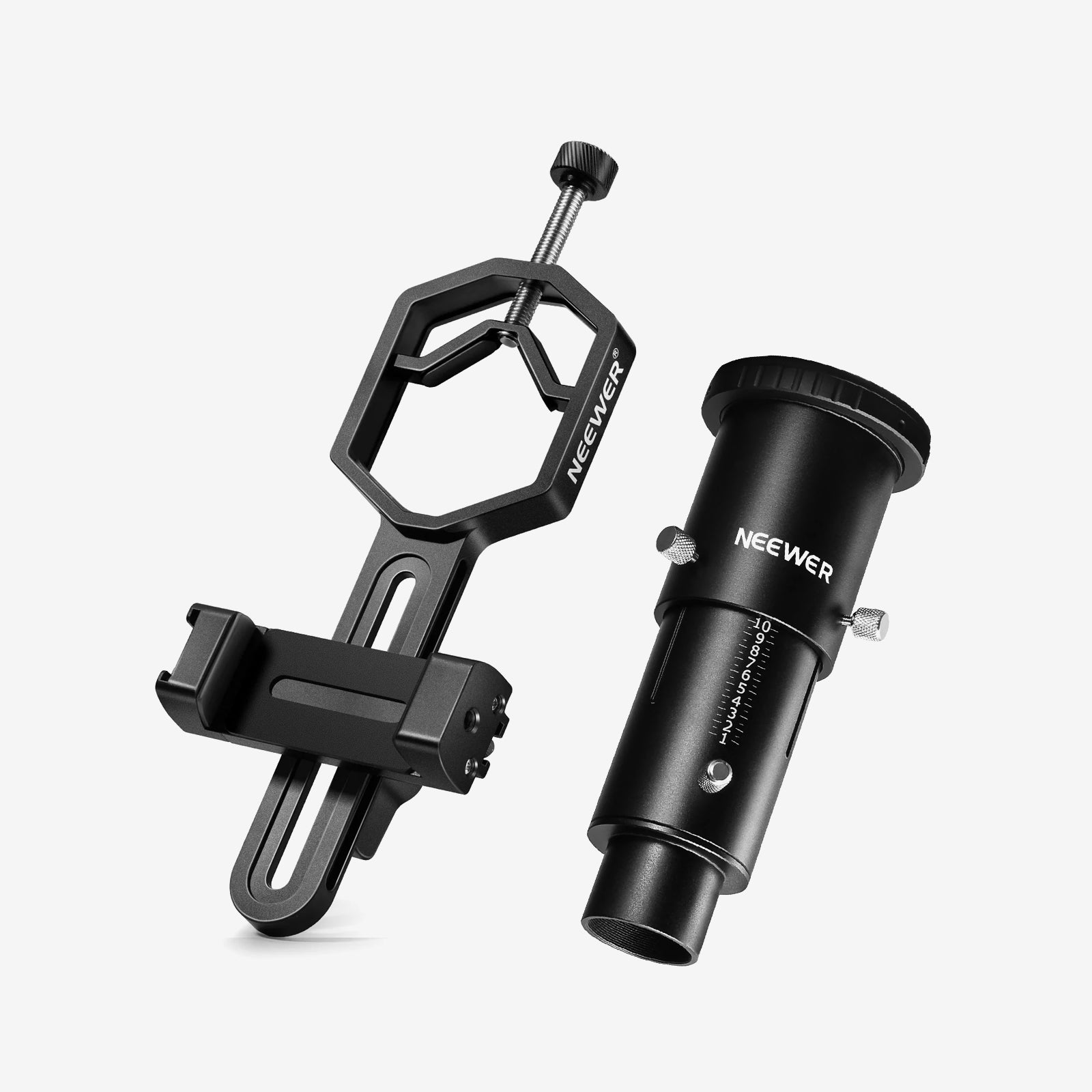
1. How Do I Attach a Telephoto Lens to My Phone Effectively?
- Identify the correct camera lens first: Attach the telephoto lens to your phone’s main 1x rear camera, not the ultra-wide or selfie camera.
- Remove the thick or raised phone case before mounting: Thick or raised cases often push the lens off-axis.
- Center the lens using live view (don’t eyeball it): Open your camera app and start at 1x or 2x zoom, slowly adjust the external lens position, and watch the screen edges for symmetry and sharpness.
- Avoid over-tightening clip mounts: Clip-on lenses should be firm enough that they don’t shift when tapped. But not so tight that the clip bends the phone body or camera bump
- Check for vignetting before locking position: Look for dark corners, one-sided shadowing, and circular “tube” effect. If you see this, reposition slightly instead of trying to crop it later.
- Do a quick test shot before important photos: Shoot something with clear edges (buildings, text, trees). If something looks off, re-seat the lens immediately.
2. Is a 200mm Telephoto Lens Enough for Wildlife Photography, or Do I Need Something Longer?
A 200mm telephoto lens can be enough for wildlife photography, but only in certain situations. It works reasonably well when you are shooting larger or more approachable animals, such as deer in open parks, animals in zoos, or wildlife during safari drives, where you can get relatively close.
However, in most real wildlife scenarios, 200mm starts to feel limiting. Animals in the wild are often farther away than you expect, especially birds, small mammals, or animals in dense forests. At that distance, the subject will appear small in the frame, and you’ll likely rely on heavy cropping afterward, which reduces image quality and detail.
So, if wildlife photography is a serious focus—especially for smaller or more distant subjects—you need lenses in the 300–600mm range provides much more flexibility and better results.
2. What’s the Difference Between a 200mm and a 300mm Telephoto Lens for Wildlife Photography?
The main difference between a 200mm and a 300mm telephoto lens in wildlife photography is reach and how tightly you can frame your subject without moving closer.
|
Attribute |
200mm Telephoto Lens |
300mm Telephoto Lens |
|
Effective Reach |
Moderate reach, suitable for closer wildlife |
Noticeably longer reach, better for distant subjects |
|
Subject Framing |
Often requires cropping for small animals |
Can fill the frame more easily without cropping |
|
Best Wildlife Scenarios |
Safari parks, zoos, and larger animals in open areas |
Birds, shy animals, and distant wildlife |
|
Image Detail |
Good, but the detail may drop after cropping |
Better detail retention due to tighter framing |
|
Flexibility in Field |
Situational—depends on how close you can get |
More consistent and reliable across conditions |
|
Shooting Experience |
You may need to physically move closer |
You can stay further away and still get strong shots |
|
Overall Use Case |
Entry-level wildlife lens |
More serious wildlife photography option |