

Table of Contents
Choosing between the MS150C and HB80C mostly comes down to how and where you shoot.
The MS150C is a higher-output RGBWW COB light designed to work as a stronger studio key light, while the HB80C focuses on portability, compact setups, and flexible accent lighting. Both share the same RGBWW engine and Bowens-mount modifier ecosystem, so both deliver very similar color performance and creative RGB flexibility. The real difference is how much light you need, how portable your setup needs to be, and where you usually shoot.
Do you need a fixed key light that can push through a softbox at typical studio working distances? A portable RGBWW light you can pack for location shoots? Or a two-light setup where one fixture handles the key and the other handles background color and depth? This guide breaks down output, portability, power options, modifier flexibility, and real-world creator use cases so you can choose the right role for each light.
Fast Answer: MS150C vs HB80C Recommendation Table
The right light depends on your primary shooting role, not just wattage.
|
Scenario |
Better Choice |
Reason |
|
Talking-head YouTube key light |
150W output pushes through softboxes; strong single-light setup |
|
|
Product photography key or fill |
MS150C |
Higher lux at distance, Bowens modifier range |
|
Portable one-light creator kit |
Mini form factor, lighter, easier to pack and position |
|
|
RGB accent or background light |
HB80C |
80W is sufficient for accent and creative fill roles |
|
Small studio with one main light |
MS150C |
Covers both key and creative modes at full studio output |
|
On-location or travel shoots |
HB80C |
Compact build reduces setup time and carry weight |
|
Two-light setup: key + RGB accent |
MS150C + HB80C |
Complementary roles; MS150C keys, HB80C accents |
|
Budget-first, minimal setup |
HB80C |
Lower cost entry into COB RGBWW without sacrificing light type |
What Is a COB Light? RGBWW Explained for Creators
COB (Chip on Board) lights concentrate multiple LED chips onto a single compact module, producing a single-point light source that behaves more like a traditional tungsten or HMI fixture than a flat LED panel. For creators, this matters because COB output is directional and shapes well with modifiers — a softbox on a COB head produces a more defined shadow fall-off than the same softbox on a flat panel. Lux at distance is often the more practical measurement because it reflects how much usable light remains after diffusion or softbox loss.
RGBWW adds two dedicated white channels — warm and cool — on top of standard RGB, allowing both high-accuracy neutral white light for interviews and product shots and full-spectrum creative color from a single fixture. Both the MS150C and HB80C use RGBWW COB technology; their color modes, light quality, and modifier compatibility are fundamentally the same. The decision between them is about output level, form factor, and power source. Both are part of NEEWER’s broader RGB lighting lineup.
NEEWER MS150C: Best Stronger RGBWW Key Light for Small Studios

The Breakdown
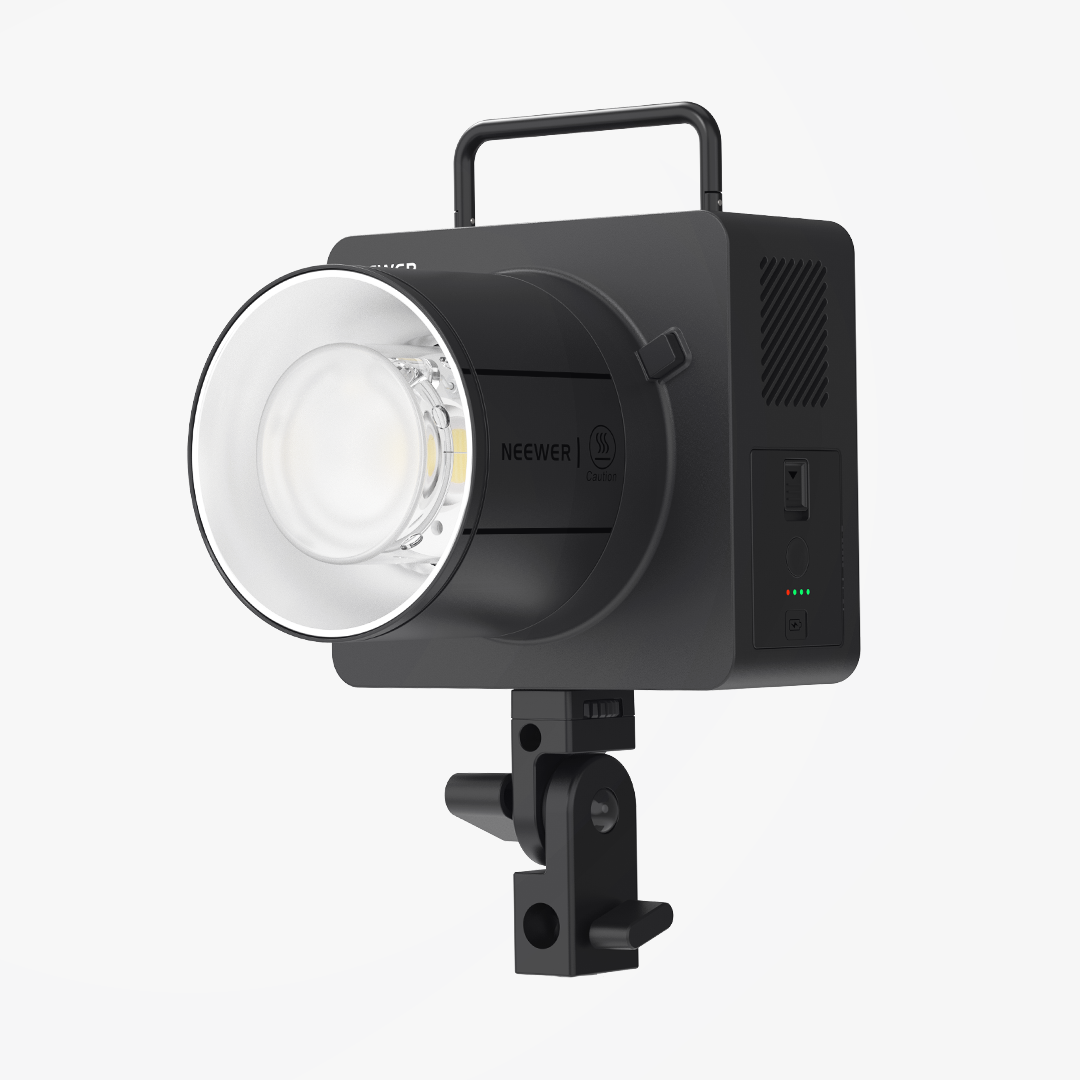
The MS150C is a 150W RGBWW COB light for fixed studio use. Its COB output reaches 16600 lux at one meter — high enough to push through a standard softbox and still produce well-exposed footage at a workable ISO. The Bowens mount also gives the MS150C more room to grow as your setup becomes more advanced, whether that means larger softboxes, grids, lanterns, or other modifiers. Control is via physical knobs, the NEEWER App (Infinity), or 2.4G wireless. V-mount battery compatibility adds some location flexibility, but in practice, the MS150C works best as a fixed or semi-permanent studio light where output consistency matters more than ultra-portability.
|
Spec |
Detail |
|
Light type |
COB (RGBWW) |
|
Max power |
150W |
|
Max illuminance |
16600 lux at 1 m (4400K) |
|
Color temperature |
2700K–6500K |
|
Color modes |
CCT, HSI, RGBCW, FX (17 scenes), SOURCE, GEL (40 presets) |
|
CRI / TLCI |
97+ / 98+ |
|
Dimming |
1%–100% (linear PWM) |
|
Modifier mount |
Bowens mount (adapter ring included) + built-in umbrella hole |
|
Control |
Physical knobs; NEEWER App (Infinity, supports hundreds of lights); 2.4G wireless (00–99 channels) |
|
Power |
AC corded; V-mount battery 16.8V compatible (battery sold separately) |
|
Dimensions |
7.7×3.7×3.6 in / 19.5×9.5×9.2 cm |
|
Weight |
2.3 lb / 1041 g |
Pros
- 150W COB output is sufficient to key-light a talking-head setup through a large softbox
- Full RGBWW system allows the same fixture to transition between standard white and RGB creative modes
- Bowens mount opens access to a wide range of light-shaping modifiers
- App control supports multi-light grouping for more complex setups
- Compact COB form factor is smaller than comparably powered panel lights
Cons
- Heavier and bulkier than the HB80C — less suited for portable or travel use
- 150W power draw requires a mains connection; V-mount battery option adds cost
- Harder light quality without a modifier — a softbox or diffusion is recommended for most creative work
Best for: Talking-head YouTube videos, small studio product photography, portrait video, creators who want a single fixture to cover both key-light and RGB creative roles
Also consider:
NEEWER CB300C — 300W RGBWW COB. The next step up from the MS150C is for larger rooms, bigger subjects, or setups that need more output through large modifiers at a distance.
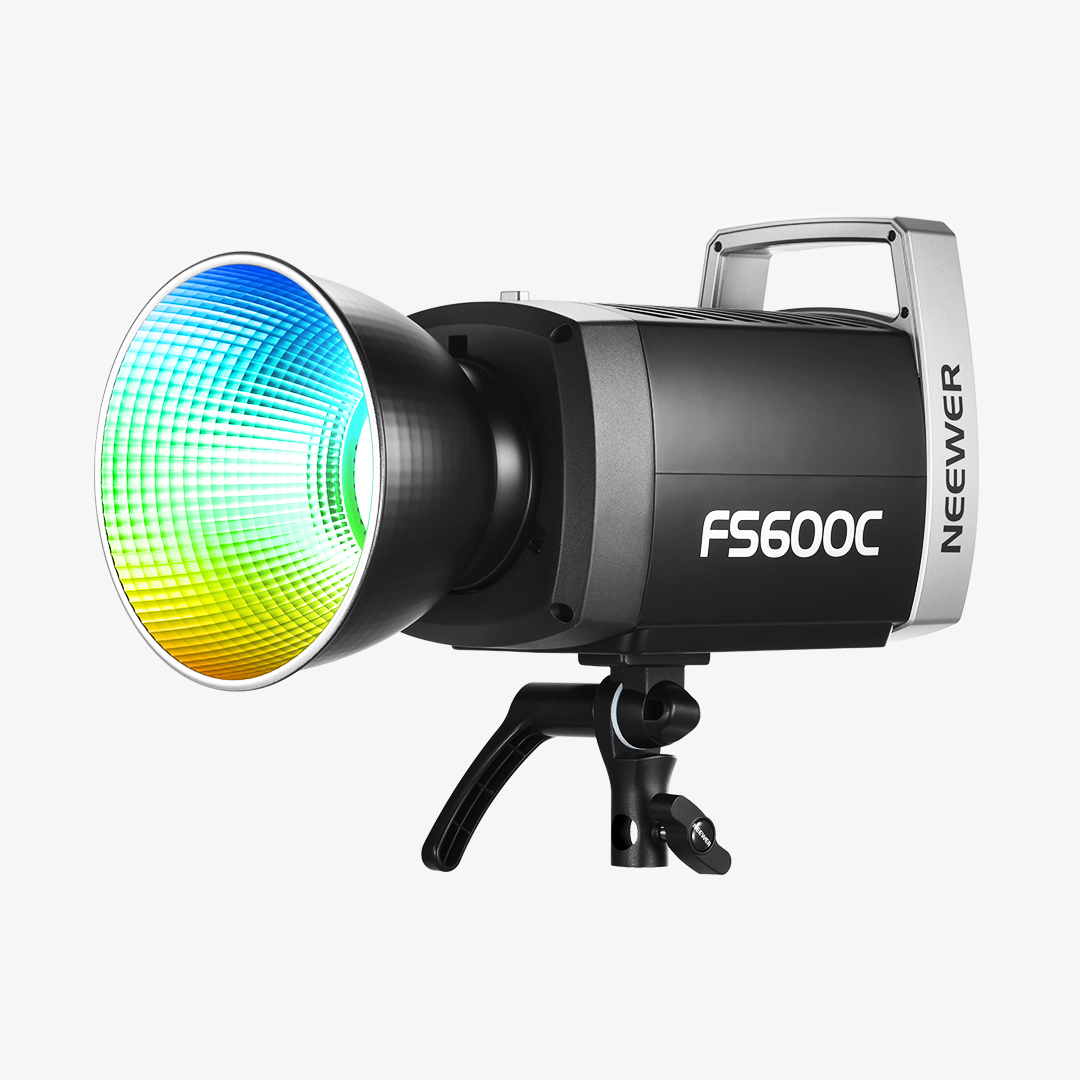
NEEWER FS600C — 600W RGB COB. Professional-grade output for demanding studio environments where 150W or 300W is not enough.
NEEWER MS150B — 130W bi-color COB. If you don’t need RGB creative modes, the MS150B delivers strong bi-color key-light performance at a lower price point.
NEEWER HB80C: Best Compact RGBWW COB for Portable Creator Setups
The Breakdown
The HB80C is an 80W RGBWW mini COB light built for portability first. Its defining advantage over the MS150C is the built-in 72Wh battery — no mains outlet or external V-mount battery required, making it genuinely portable for on-location work. At close working distances, the HB80C has enough output to function as a standalone key light for talking-head videos, livestreams, and tabletop product setups. Three power modes (mute 45W / regular 65W / booster 80W) allow you to balance output, battery life, and fan noise depending on the shooting environment. In most creator rigs, the HB80C’s natural role is RGB accent, fill, or rim light alongside a stronger key — its 2500K–7500K CCT range is actually wider than the MS150C’s, and both share the same Bowens mount modifier ecosystem.
|
Spec |
Detail |
|
Light type |
COB (RGBWW) |
|
Max power |
80W
|
|
Max illuminance |
10400 lux at 1 m (4400K, with reflector); 3700 lux at 1 m (bare lamp) |
|
Color temperature |
2500K–7500K (Duv ±0.0003) |
|
Color modes |
CCT, HSI, RGBCW, XY, GEL, Source Match, FX (7 modes); 18 special effects scenes |
|
CRI / TLCI |
95+ / 97+ |
|
Dimming |
0–100% |
|
Modifier mount |
Bowens mount + umbrella socket (reflector included) |
|
Control |
Physical controls; NEEWER App (Infinity); 2.4G wireless (00–99 channels) |
|
Power |
Built-in 72Wh battery (14.4V / 5000mAh); Type-C PD charging (PD 65W fast charge, 2 hours) |
|
Battery life |
70 min (regular mode); 94 min (mute mode) |
|
Dimensions |
5.12×5.12×2.76 in / 13×13×7 cm (bare lamp) |
|
Weight |
/ |
Pros
- Mini COB form factor is easier to transport, position, and use in compact spaces
- RGBWW system covers both standard white light and full creative RGB hue control
- 80W output is well-matched to accent, fill, and close-range key-light roles
- Lower cost entry point into RGBWW COB technology compared with higher-wattage options
- App control available for multi-light integration with other NEEWER fixtures
Cons
- Lower maximum output than the MS150C — less suitable as a primary key light when pushing through large modifiers at standard working distances
- 80W may not be sufficient for larger subjects or when more working distance is required
- Booster mode (80W) requires a PD 100W charger; without it, output is capped at regular mode (65W)
Best for: Portable creator setups, compact studio accent and fill lighting, travel content production, two-light setups where the HB80C fills a secondary or accent role, and creators starting with RGBWW COB
Also consider:
NEEWER HS60C — 60W portable RGB LED. Lighter and more compact than the HB80C, with a panel form factor suited for travel kits and setups where pack size is the first priority.
Key Differences: Output Role, Portability, Modifiers, Power, Setup Size
Both lights share the same fundamental RGBWW COB technology. The differences are about role, scale, and workflow fit.
|
Feature |
MS150C |
HB80C |
|
Power output |
150W (AC); 95W (V-mount battery) |
80W (booster, pd100w charger needed); 65W (regular); 45W (mute) |
|
Primary role |
Main key light |
Accent, fill, or compact key light |
|
Max illuminance |
16600 lux at 1 m |
10400 lux at 1 m (with reflector) |
|
CCT range |
2700K–6500K |
2500K–7500K (wider range) |
|
CRI / TLCI |
97+ / 98+ |
95+ / 97+ |
|
Color modes |
6 modes (CCT/HSI/RGBCW/FX/SOURCE/GEL); |
7 modes (CCT/HSI/RGBCW/XY/GEL/Source Match/FX); |
|
Special scene effects |
17 |
18 |
|
Form factor |
Compact COB studio head |
Mini COB — smaller and lighter |
|
Modifier mount |
Bowens mount (adapter ring included) |
Bowens mount + umbrella socket (reflector included) |
|
Battery |
No built-in battery; (adapter ring included) |
Built-in 72Wh; Type-C PD charging |
|
Portability |
Moderate — primarily a studio / AC fixture |
High — built-in battery, genuinely portable |
|
App control |
NEEWER App (Infinity); 2.4G (00–99 channels) |
NEEWER App (Infinity); 2.4G (00–99 channels) |
|
Setup size |
Suited to a fixed or semi-permanent studio |
Suited to compact or travel setups |
|
Price |
$279.99 |
From $209.99 (Basic Kit) |
Which Is Better for YouTube and Talking-Head Videos?
The MS150C is the stronger key light for a fixed YouTube setup. In a typical desk or studio setup, the MS150C has enough output headroom to stay comfortably bright even after adding a softbox or diffusion, which makes exposure easier to maintain across different room sizes. The Bowens mount also gives you room to experiment with larger softboxes, grids, lanterns, and other modifiers as your setup evolves.
The HB80C at 10400 lux is a usable YouTube key light for close-range setups, but the MS150C’s output headroom makes it more reliable across different rooms and conditions as a fixed solo setup.
Which Is Better for Product Photography?
The MS150C is the more capable option for product photography. Large softboxes and diffusion materials reduce usable brightness quickly, so extra output becomes important for keeping cleaner low-ISO exposures and more flexible camera settings. The Bowens mount adapts to a wide range of softbox sizes for different product scales.
The HB80C’s 10400 lux handles tabletop products at close range with a small diffuser, but is better suited to a secondary accent role — adding a rim light or background color wash — than as the primary key for larger or more demanding product setups.
Which Is Better for RGB Creative Lighting?
Both lights cover the same creative RGB territory — full RGBWW spectrum, gel presets, and FX scene effects. The MS150C at 150W produces more saturated, room-filling color at distance, making it the stronger choice for wide background color washes or bold rim lights. The HB80C at 80W is better matched to accent and fill creative roles: easier to position close to the subject, tucked behind furniture, or used as a colored practical light in frame.
For most creative setups, the most effective arrangement is MS150C as key (with softbox) and HB80C as a hue-adjustable accent, both controlled from the NEEWER App on the same 2.4G channel.
Suggested NEEWER Setup Combinations
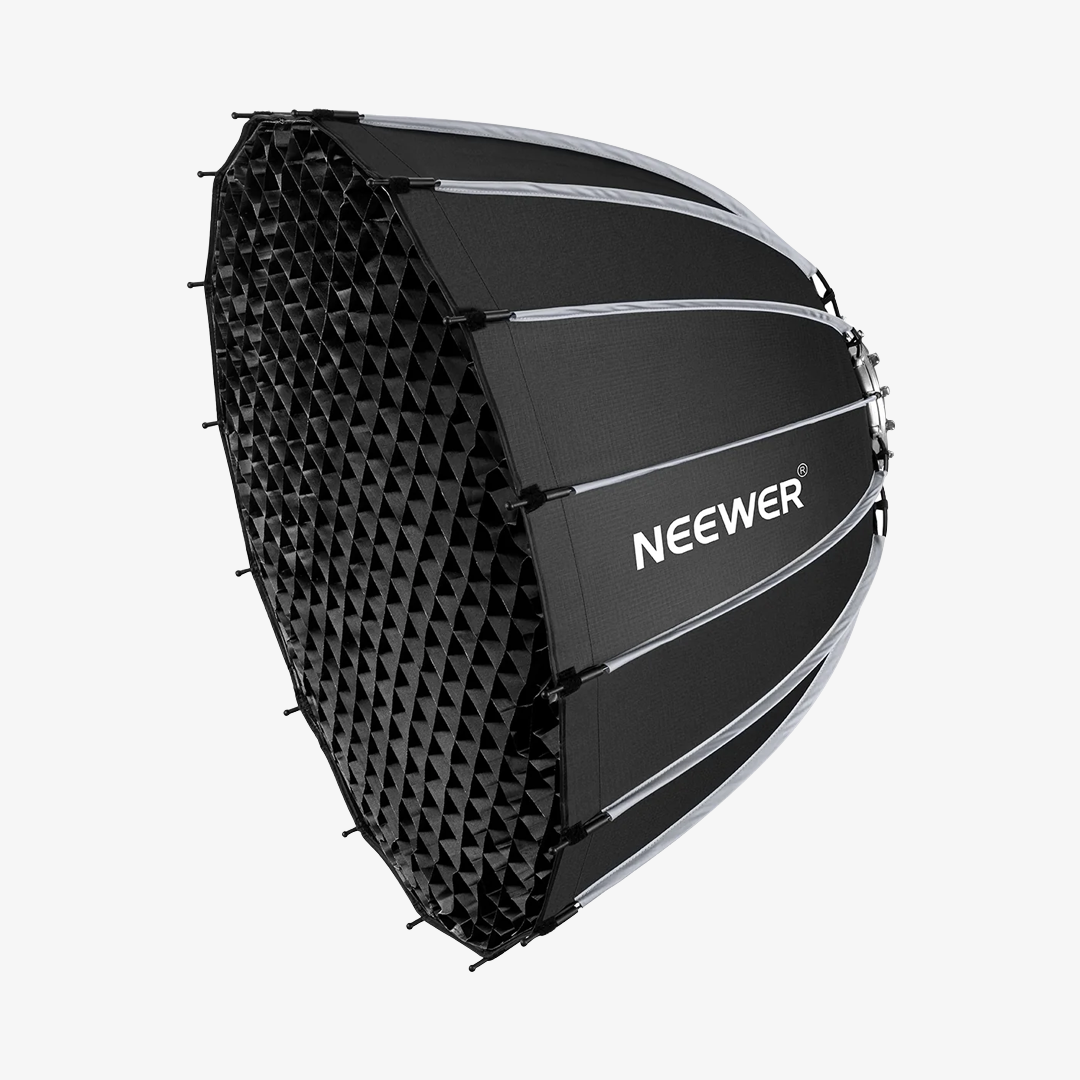
One-light small studio setup: MS150C + Bowens softbox (60×60 cm or 60×90 cm) + light stand. Use the MS150C in CCT mode for standard work; switch to RGBWW modes when creative RGB accents are needed.
Two-light creator setup: key + accent: MS150C as the softened key light + HB80C as the RGB accent or rim light. This arrangement separates the subject from the background more effectively, helping smaller creator spaces look cleaner and more dimensional on camera. The MS150C handles neutral, well-exposed key light; the HB80C handles accent color, rim light, or background fill. Both controlled via the NEEWER App. This is an effective arrangement for talking-head video with a distinct visual identity. For a two-person interview setup with two cameras, the MS150C handles key light for the primary subject while the HB80C works as a background or separation light; a second key or fill source would be needed to light the second subject evenly.
Portable travel setup: HB80C + Bowens-mount modifier (softbox or reflector) + compact light stand. The built-in 72Wh battery and Type-C PD charging mean no AC outlet is required. Suitable for on-location social content, run-and-gun video, and tabletop product work in hotel rooms or temporary spaces.
Which Should You Choose?
Use the criteria below to make the call — each light’s strengths and limitations sit side by side so you can match them to your actual workflow.
MS150C
- Choose it if: you need a primary key light for a fixed home studio; you shoot talking-head YouTube at normal working distances (1–2 m) and want the light to push through a softbox effectively; product photography is part of your workflow and you need lux headroom for low-ISO exposures; you want a single fixture that covers both key-light and creative RGBWW roles; you plan to use Bowens-mount modifiers.
- Skip it if: portability is your priority — 150W AC draw and the fixture’s weight make it inconvenient on location; you only need a small accent or background color light and do not need the key-light output; your space is very small, and you shoot at very close range, where 150W can be hard to control without heavy diffusion.
HB80C
- Choose it if: portability and compact setup come first; your main need is an accent, fill, or background color light rather than a primary key; you shoot in small spaces where 80W is sufficient; you are building a two-light setup and need a complement to a stronger key light; you are entering RGBWW COB for the first time and want a lower-cost starting point.
- Skip it if: you need a main key light that pushes through a large softbox at 1.5–2 meters — 10400 lux at one meter drops significantly through a large diffuser and may not be sufficient at distance; you photograph larger subjects or shoot in larger rooms where more output headroom is required; you are building a single-light setup that must cover both key and creative duties.
Both lights if: you want a complete two-light RGBWW COB rig — MS150C as key, HB80C as accent and fill — or you produce both polished studio video and portable location content and want a setup that covers both scenarios.
FAQs
Is the NEEWER MS150C good as a YouTube key light?
Yes. Its 150W COB output reaches 16600 lux at one meter — enough to push through a medium or large Bowens softbox at typical talking-head distances and arrive at a well-exposed subject without pushing ISO. CRI is 97+, and TLCI is 98+, and the 2700K–6500K CCT range handles any ambient room tone.
What does RGBWW mean on a COB light?
RGBWW adds two dedicated white channels — warm and cool — to standard RGB, producing high-accuracy neutral white light for interviews and product shots alongside full-spectrum creative color. On a COB fixture, all channels mix from a single optical point, giving more consistent color across the beam than multi-chip panel designs.
What is COB lighting and why does it matter for video?
COB packages multiple LED chips into a single lighting module, creating a point-source light with directional output and defined shadow edges. That makes it easier to shape with softboxes, grids, or beauty dishes — resulting in more three-dimensional light quality compared with the flatter output of a standard LED panel.
Do the MS150C and HB80C need a softbox?
Neither requires one — both can be used bare for hard, directional light or creative color effects. For most video and portrait work, a softbox produces more flattering results. Both lights use a Bowens mount (the HB80C also has an umbrella socket), so they share the same softbox and modifier ecosystem.
Can I use the MS150C and HB80C together in the same setup?
Yes — MS150C as key light, HB80C as accent, fill, or background is one of the most practical RGBWW COB two-light arrangements. Both support NEEWER App (Infinity) and 2.4G wireless grouping on the same channel, so you can adjust color, intensity, and mode for both lights from one place.
Final Thoughts
The MS150C and HB80C are not competing products — they occupy different roles in the same RGBWW COB ecosystem. The MS150C is the strongest light in the room: high output, full Bowens modifier range, a single fixture for studio video, product photography, and creative RGB work. The HB80C goes where the MS150C cannot: built-in 72Wh battery, mini form factor, 80W RGBWW COB output that handles accent, fill, and close-range key-light duties on location or in compact spaces.
Start with the light that matches your primary environment, then add the second when the setup demands it. Studio-first creators reach for the MS150C; location-first or compact creators start with the HB80C and add the MS150C as their studio work grows. Together, they form a scalable RGBWW COB lighting system that covers everything from compact creator desks to more advanced studio workflows.