

Table of Contents
You finally have the right angle for your video — great hook, solid energy — and then you hit playback, and everything looks flat. The background wall is a muddy grey, your face is either washed out or lost in shadow, and the vibe you wanted just isn’t there. In a small bedroom or apartment, the problem isn’t your camera. It’s that most lighting advice assumes you have space you don’t have.
For most TikTok and Reels creators, a simple two-light setup works better than adding more gear. Start with a key light placed about 45° from the camera, then add a low-power RGB accent behind you for background separation.
In a small room, the NEEWER HB80C works well as a compact key light, while the SL50 and FL20 are easier to use as portable accents or fill lights.
Quick Comparison: HB80C vs SL50 vs FL20 for Small-Room TikTok
Each of these lights solves a different problem. The best choice depends more on how you shoot than on the raw specifications.
|
Your situation |
Best pick |
Why |
|
You need a bright, clean main light — face looks flat or dark on camera |
Highest output in this lineup; |
|
|
You already have a key light and want background color separation |
SL50 |
Magnetic — no stand needed; |
|
You want the longest battery runtime and a light you can take anywhere |
FL20 |
180-min battery life; |
|
Your room is under 10 ft wide and floor space is the constraint |
Sticks to shelves magnetically, zero floor footprint |
|
|
You want one light that works for both video and product flat-lay |
HB80C |
RGBWW + Bowens mount covers both use cases |
|
Budget is under $35 and |
SL50 |
$29.99 |
|
You shoot for 3+ hours |
180-min runtime; |
|
|
You want creative beam effects — gobos, snoot, focused spot |
FL20 |
10°–60° zoom; |
The two-light sweet spot for most small rooms: HB80C as key at 45° + SL50 tucked on a shelf behind you for color separation. Add the FL20 when you need a third option for travel or extended shoots.
What Is a Portable RGB Light Used For?
In practice, most creators use portable RGB lights for one of three reasons: lighting their face, filling in shadows, or adding color to the background. Per IES (Illuminating Engineering Society) guidance on video lighting, controlled color temperature and directionality are foundational to predictable on-camera results; RGB lights extend this by adding hue control beyond the traditional white-to-warm range.
In video and photography, portable RGB lights serve three main roles:
- Key light: A higher-output compact RGB like the HB80C can serve as your primary subject light, delivering adjustable white plus full color in one unit — useful for creators who shift from neutral skin-tone content to color-themed videos without swapping gear.
- Fill light: A low-power pocket RGB like the FL20 fills in the shadow side of your face at 1:1 to 2:1 ratio with the key, softening harsh contrast in a single room shoot.
- Accent / atmosphere light: Wand-style lights like the SL50 add background color separation — the visual layer that makes small-room content look intentional rather than improvised.
For vertical-video creators, bi-color vs RGB is a real fork: bi-color gives you white-range flexibility at lower cost; full RGB gives you the hue control that makes TikTok/Reels content visually distinctive. When your content style includes color-themed segments, branded backgrounds, or mood shifts between clips, full RGB earns its place.
Small-Room TikTok/Reels RGB Setup: Step-by-Step
A two-light portable RGB setup is the most space-efficient starting point for vertical video in a small room. Follow these steps to build a clean, separation-forward look without eating up floor space.

Step 1 — Place Your Key Light at 45°
Set your key light roughly 45° to one side of your camera, at eye level or slightly above. Choose a neutral white (5600K) or warm white (3200K) depending on your room’s ambient tone. In a small room, 3–4 feet of working distance is enough — keep brightness at 50–70% to avoid blown-out skin tones on camera.
Step 2 — Set Your Key-to-Accent Ratio
Your key light should be noticeably brighter than your accent. A good starting ratio is 3:1 to 4:1 — meaning if your key is at 60% power, your accent should be at 15–20%. This keeps your face as the focal point while still letting the background color show up on camera.
Step 3 — Place Your RGB Accent Behind You
Place a low-power RGB accent light on a shelf, dresser, or floor stand behind and slightly to one side of you. Choose a color that contrasts with your outfit and wall tone: a cool teal or purple against a warm neutral backdrop creates immediate visual depth. Aim it at the wall rather than directly at the camera to keep the color diffuse.
Step 4 — Control Spill in Tight Spaces
In rooms under 10 feet wide, light bounces off walls fast. If your RGB accent is bleeding too much color onto your face, move it further behind your shoulder line, reduce its brightness, or angle it toward the floor instead of the wall. For the HB80C, use a snoot attachment (Bowens-mount compatible) or reduce the reflector angle to limit spill on the background.
Step 5 — Frame and Review in Vertical
Before recording, switch your phone or camera to vertical orientation and check the live view. Your key light should create a clear shadow under your cheekbone (Rembrandt triangle or butterfly pattern, depending on angle). The accent color should be visible in the background without competing with your face brightness.
Best Compact RGB Lights for Apartments
In most apartment setups, raw wattage is only part of the decision. Whether a light needs a dedicated floor stand, how long it runs on a single charge, and whether it can compete with ambient daylight all matter just as much. The three picks below address each of those constraints from a different angle.
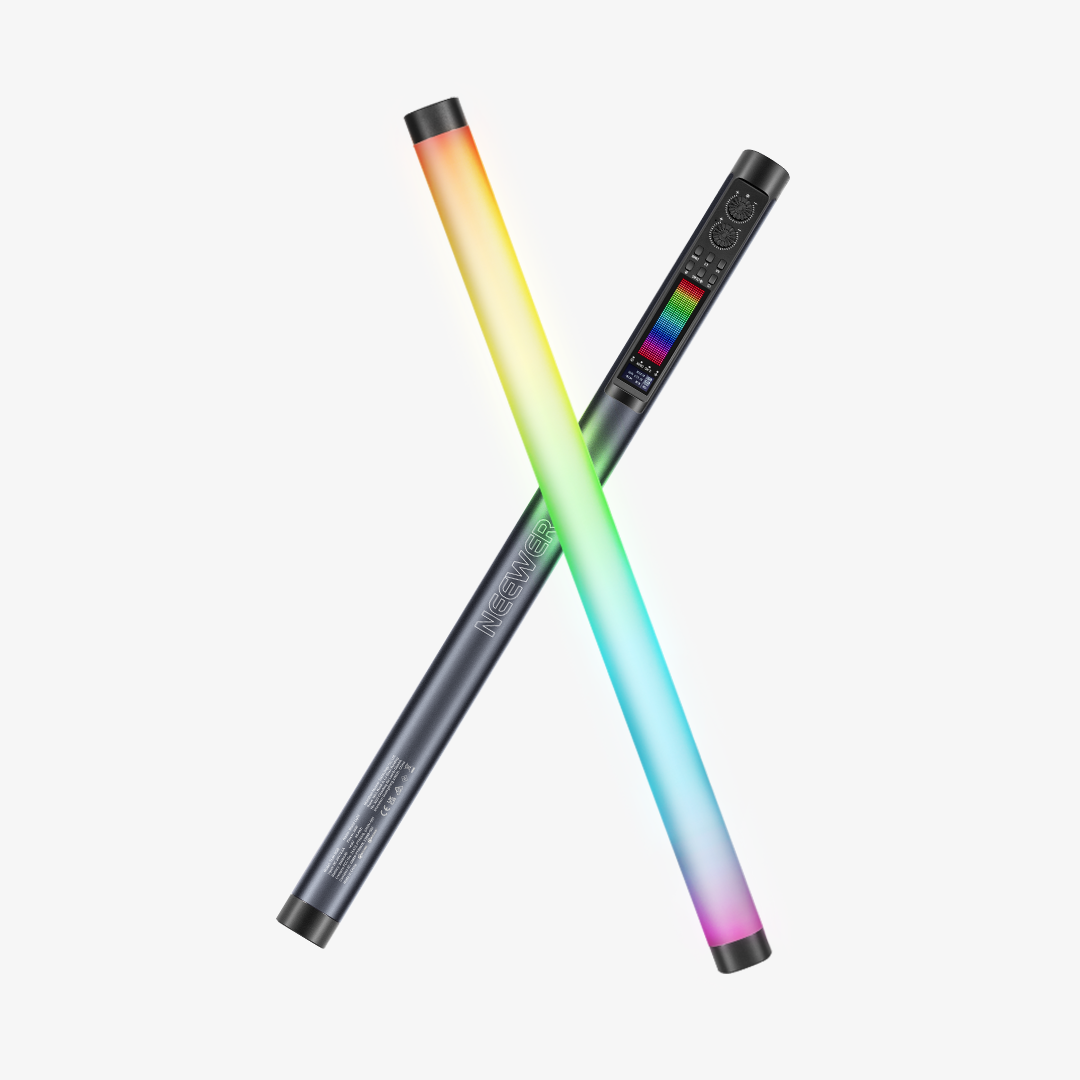
For small studios and apartment creators, light sticks are also worth a look as a supplemental accent option — slimmer profile, versatile positioning, and compatible with the same two-light layout described in this guide.
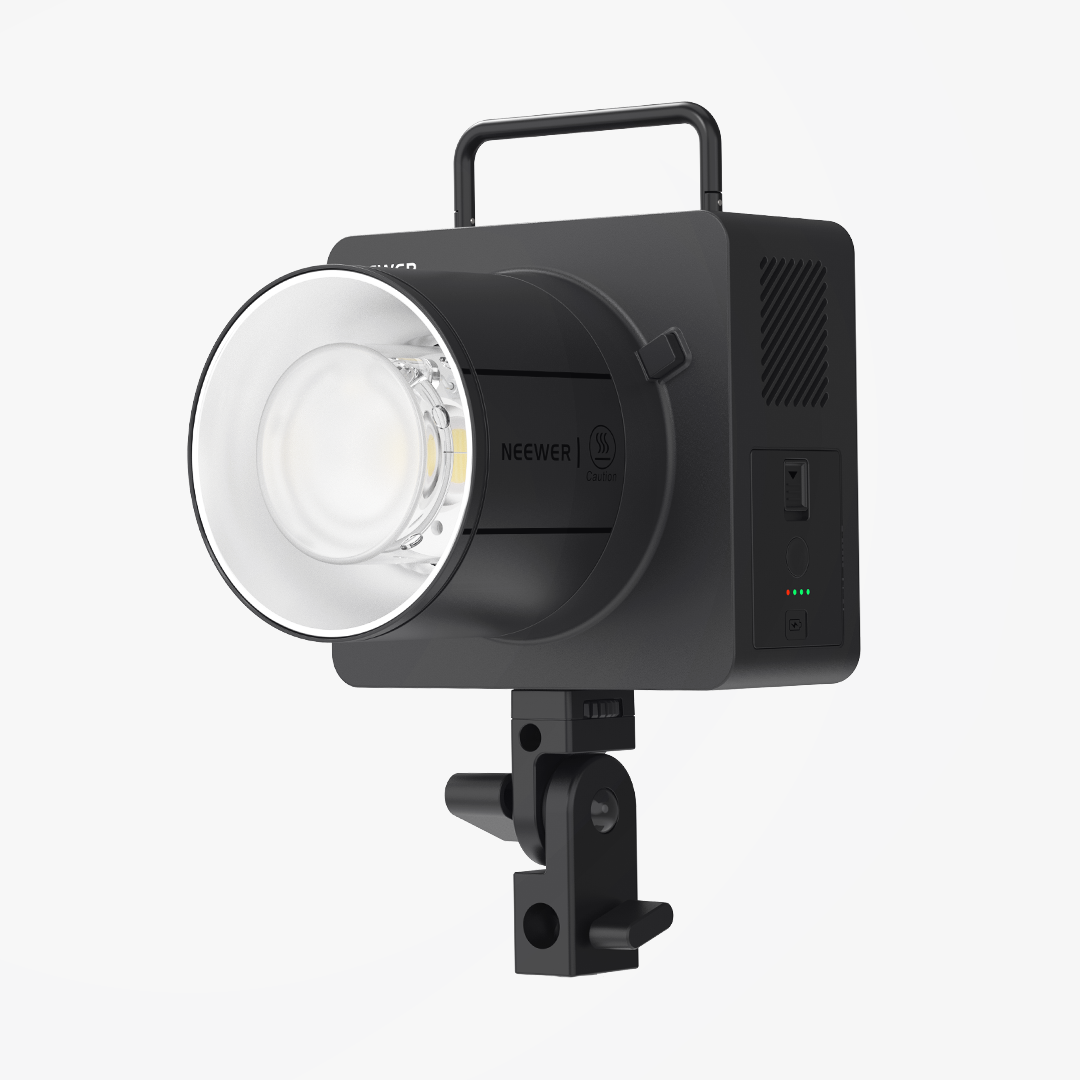
a. NEEWER HB80C: Best Compact RGB Key Light for Small-Room TikTok
If your face looks flat or dark on camera — or your ring light is giving you that washed-out even glow with no shadow definition — the issue usually comes down to direction, not brightness. Unlike a ring light, the HB80C produces directional light that can be shaped with softboxes, snoots, and other Bowens-mount modifiers. In a small room, that means cleaner face separation from the background without needing a larger fixture. The 80W output runs off a built-in 72Wh battery, and the RGBWW engine covers 2500K–7500K, so you’re not locked into a single white tone when your content style changes.

The Breakdown
|
Spec |
Detail |
|
Type |
Mini COB LED video light |
|
Power |
80W |
|
Max illuminance |
3,700 lux/m bare; |
|
Color range |
2500K–7500K RGBWW |
|
CRI / TLCI |
95+ / 97+ |
|
Battery |
72Wh (14.4V / 5000mAh), built-in |
|
Battery life |
~70 min (regular) / ~95 min (mute) |
|
Beam control |
Bowens mount + umbrella socket |
|
Mounting |
Bowens mount; |
|
Control |
NEEWER Infinity app + 2.4G wireless |
|
Size |
5.12"×5.12"×2.76" / 13×13×7 cm |
Pros
- 80W with built-in battery — true cordless key light, no outlet required
- RGBWW covers 2500K–7500K white range plus full creative color in one unit
- CRI 95+ / TLCI 97+ ensures accurate skin tones and product color on camera
- Bowens mount accepts softboxes, beauty dishes, snoots, and umbrellas
- App + 2.4G wireless; syncs with other NEEWER 2.4G lights in the same channel group
Cons
- Heavier than pocket-style options — best desk- or stand-mounted, not handheld
- Output drops at full RGB saturation vs CCT white mode (standard COB behavior)
- Boost mode (80W) requires a PD100W charger for full performance; not in basic kit
Best For: Apartment creators replacing a ring light or softbox as their key light — especially anyone who shoots both talking-head video and product flat lays in the same small room and needs one light to handle both.
If you want a second RGB light that syncs with the HB80C wirelessly, the NEEWER TL120C 42W RGB Tube Light connects via the same 2.4G channel and adds a wider, softer background color strip — a step up from a wand accent when you’re ready to invest in the full setup.
b. NEEWER BASICS SL50: Best Magnetic RGB Wand for Accent and Atmosphere
If your videos look flat because everything is one even tone — no background separation, no visual depth — a second light is the fix, and in a small room the constraint is usually stand space. The SL50 skips the stand entirely: it magnetically sticks to any metal shelf, dresser, or cabinet edge, runs 105 minutes on a charge, and costs $29.99.

The Breakdown
|
Spec |
Detail |
|
Type |
RGB light wand |
|
Power |
14W |
|
Max illuminance |
840 lux/0.5m |
|
Color range |
CCT: 2700K / 4000K / 6500K; |
|
CRI |
95 |
|
Battery |
14.8Wh (3.7V / 4000mAh) |
|
Battery life |
105 min |
|
Beam control |
Bare 21" strip — wide, soft side light |
|
Mounting |
1/4" threaded holes (both ends) + magnetic adhesion |
|
Control |
Button only |
|
Size |
21.1"×1.7"×1.7" / 53.5 × 44 × 44 cm |
|
Weight |
13 oz / 370 g |
Pros
- Magnetic back attaches to shelves and metal furniture — no stand needed
- 21" strip length creates a wide color sweep across backgrounds
- 36 FX effects including 3 sound-reactive modes for dynamic content
- 105-minute runtime; recharges via USB-A to USB-C from any power bank
- One of the most affordable ways to add RGB background separation to an existing setup
Cons
- 840 lux/0.5m is accent-level output — not a solo key light
- CCT mode limited to three fixed temperatures (no continuous dial)
- No app or wireless control
Best For: Creators who already have a key light and need background color separation without adding another floor stand. The go-to second light in a small-room two-light layout.
If you find yourself wanting more output from a handheld RGB format — or need to cover a larger background — the NEEWER BASICS GC30C 30W RGB Handheld Inflatable LED Fill Light delivers roughly 2× the wattage in a portable, packable form.
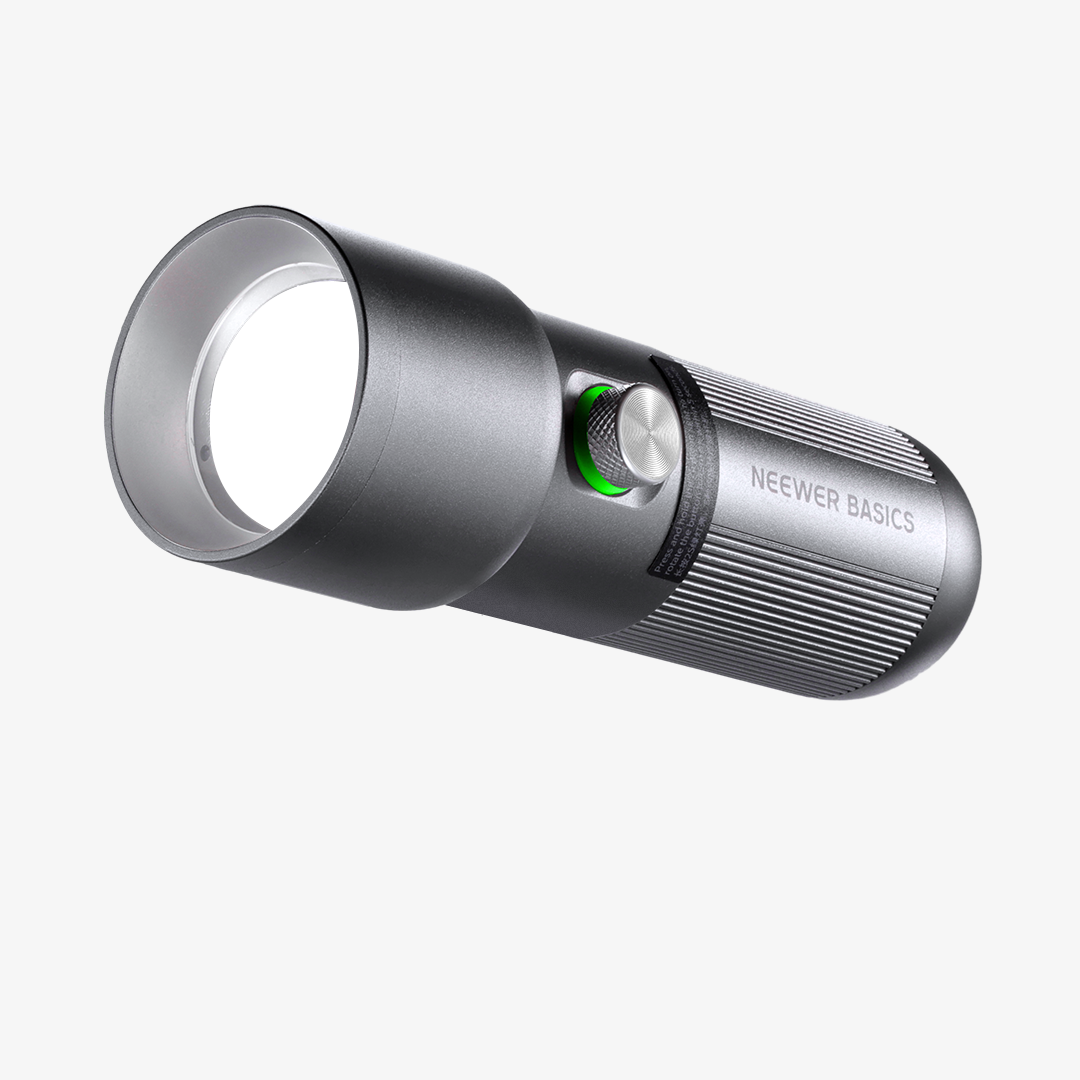
c. NEEWER BASICS FL20: Best Pocket RGB Fill Light for Tight Spaces
If you’re filming away from a power outlet for hours at a stretch, or you need a light that fits into a camera bag without taking up the space your lenses need, the FL20 is the practical answer. 180 minutes of battery life at full 20W, a zoom barrel that shifts from a focused 10° spot to a soft 60° spread, and gobo filters included in the box — all in a 7"×2" body.

The Breakdown
|
Spec |
Detail |
|
Type |
Portable focusable RGB flashlight |
|
Power |
20W |
|
Max illuminance |
3,000 lux / 0.5 m (2000K yellow light) |
|
Color range |
Full RGB |
|
CRI / TLCI |
95+ / 96+ (white light) |
|
Battery |
49.95Wh (11.1V / 4500mAh) |
|
Battery life |
180 min at max power |
|
Beam control |
Zoom 10°–60° (push-pull barrel) |
|
Mounting |
1/4" thread hole × 3 |
|
Control |
Button only |
|
Size |
7"×2" / 17.7×5.2 cm |
|
Weight |
1.2 lb / 543 g |
Pros
- 180-minute runtime at full power — outlasts both SL50 and HB80C without a recharge
- 10°–60° zoom shifts from spotlight to wide fill without any modifier swap
- 20 gobo filters and silicone snoot included for creative effect work out of the box
- Supports charging while in use — stay plugged in for marathon sessions
- Three 1/4" mounting points for use with a mini tripod, light stand, camera rig, selfie stick
Cons
- 3,000 lux/0.5 m works well for fill and accent but won’t compete with daylight as a solo key
- No app or wireless control
- Zoom barrel makes it thicker than the SL50 wand; less pocket-flat for travel
Best For: Creators who shoot 2–3 hour sessions, need creative beam effects (gobo, spot, snoot), or want one portable light that covers both video fill and product macro work in a single kit.
If you’re looking for other portable RGB options to round out your setup, the NEEWER mini lights collection covers a range of compact form factors — from wands to inflatable fills — at different output levels and price points.
If you also shoot outdoors, portable RGB lighting behaves quite differently once you’re competing with daylight — output requirements, battery needs, and weather resistance all change. For that, see the dedicated guide to outdoor portable video lighting.
Wand vs Flashlight Pocket Lights
The SL50 (wand) and FL20 (flashlight) share a portable, battery-powered form factor but serve slightly different creative roles. In short: wand lights emit a softer, broader side light well-suited for rim lighting and background color strips, while flashlight-body lights project a more directional beam better suited for focused fill or handheld effects.
For a detailed comparison of wand vs flashlight pocket RGB lights — including beam angle charts and creative effects use cases — see the dedicated guide to RGB pocket lights. That article covers the pocket RGB form factor in depth; this guide focuses on how those form factors integrate into a small-room TikTok layout.
FAQs
What lights do TikTokers use in small rooms?
A common small-room TikTok setup is a compact key light positioned at roughly 45°— a mini COB like the NEEWER HB80C works well here — paired with a low-power RGB accent placed behind the subject for background color separation. Ring lights are still popular for close-up beauty content, but they tend to produce flat, even illumination that doesn’t give you the background depth that most vertical video now relies on.
Can I use a portable RGB light as my only light for TikTok?
A higher-output portable RGB like the HB80C can function as a solo key light in a dim room, but results improve significantly with a second low-power accent. One light gives you brightness; two lights give you dimension and the visual depth that separates polished content from flat footage. Start with one strong key, then add an accent when the setup budget allows.
What is the best color temperature for TikTok face lighting?
5500–5600K (daylight) works for most skin tones in natural-looking videos. 4000–4500K (neutral white) is slightly warmer and flatters more skin tones in warm-toned rooms. Avoid mixing cool daylight from a window with tungsten-range RGB on your face — the mixed color cast reads poorly on video. The HB80C’s RGBWW range covers both ends, so you can dial in the right match without gel corrections.
What’s the difference between a ring light and a portable RGB panel for TikTok?
Ring lights produce a characteristic circular catch-light and flat, even illumination — good for close-up beauty and makeup content. Portable RGB panels and COB lights like the HB80C produce directional light with a natural shadow gradient, which reads more cinematically on vertical video and gives you separate key and accent control. For a full comparison of light modifiers, see ring light vs softbox.
How many watts do I need for TikTok lighting in a small room?
For a bedroom or apartment under ~150–200 sq ft, 60–80W from a compact COB key light like the HB80C is generally sufficient to produce clean subject brightness. The SL50 at 14W and the FL20 at 20W work as fill and accent in that same space but won’t function as sole key lights in a daylight-competing room. The FL20’s 3,000 lux/0.5m output makes it the stronger of the two for close-range fill; the SL50’s 840 lux/0.5m is best reserved for color accent and background separation.
Do portable RGB lights work for Reels too, or just TikTok?
Portable RGB setups work identically for Instagram Reels, YouTube Shorts, and any vertical video format — the 9:16 vertical frame, face-level composition, and background color separation principles are the same across platforms. The two-light compact layout described in this guide applies to any short-form vertical content workflow.
Can I use these lights for product photography too?
Yes — the HB80C particularly suits flat-lay and close-range product shots when paired with a diffusion modifier. The HB80C’s RGBWW range and output also make it a practical crossover between video key light and product light in a small studio.
Final Recommendation
Small-room TikTok and Reels lighting doesn’t require a full studio kit — it requires the right two lights in the right positions. The HB80C handles the key light role with genuine output and RGBWW flexibility, the SL50 adds background color and visual separation without taking up floor space, and the FL20 gives you the most portable fill option when space is truly at a premium.
If you’re starting from scratch, put your budget into a strong key light first. Once your face is lit cleanly, a $30 RGB accent will do more for the overall look of your video than adding a second key ever would.